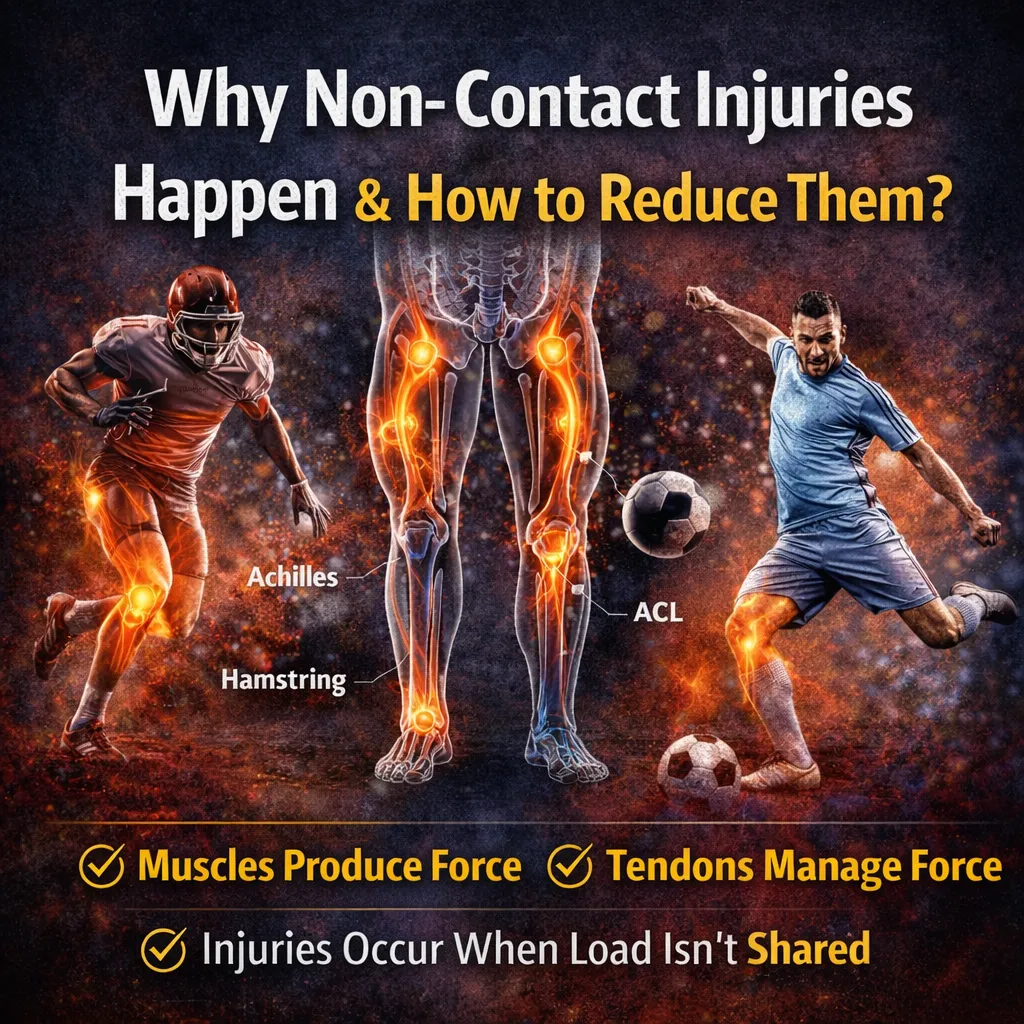
The Real Reason Hamstrings, ACLs, and Achilles Tendons Fail
The Inside Scoop on Why Non-Contact Injuries Happen and How to Reduce Them
We have never had better athletes. They are stronger, faster, and more physically prepared than ever before. Yet non-contact injuries continue to dominate professional sport. Hamstrings, ACLs, Achilles tendons. Injured without collision, often during routine movements.
That reality tells us something important.
Non-contact injuries are rarely about a single weak tissue. They are about how force is shared, or not shared, across the system.
The real issue is not strength. It is orchestration.
Muscles Produce Force. Tendons Decide What Happens to It.
Most strength and conditioning professionals understand muscles. They know which muscles extend, flex, rotate, stabilize, and produce force. They train strength, power, and capacity effectively.
That is not the gap.
The gap is that muscle knowledge has not fully translated into tendon understanding.
Muscles generate force. Tendons manage it.
Muscle strength tells us how much force an athlete can produce. Tendon capacity determines how that force is timed, transmitted, absorbed, and shared across the body. Two athletes can test equally strong yet carry very different injury-risk profiles because their tendons behave differently under speed, fatigue, and chaos.
This is why non-contact injuries rarely appear during controlled testing. They emerge during moments of rapid force transfer, when tendons are asked to coordinate and tolerate load in milliseconds.
Tendon Failure Is Rarely a Muscle Failure
When we say tendons fail in isolation, we are not saying muscles stop working. Muscles may still be producing force, but the tendons responsible for managing that force are no longer prepared or available to do their job.
That is not a muscle problem. That is tendon blindness.
To understand tendons, we must understand the muscles attached to them. Tendons do not act independently. If we do not know which muscles are meant to contribute, how they share load, and why they might drop out under speed or fatigue, we cannot fully understand why force suddenly concentrates and injuries occur.
Knowing the names is not academic. It is foundational.
Load Sharing Is the Missing Injury Variable
In performance conversations, tendon focus often centers on the Achilles, patellar, and quadriceps tendons. These tissues matter, but the human body contains thousands of tendons. Non-contact injuries occur when too few of them are available at a critical moment.
Tendons are not just connectors between muscle and bone. They are regulators. They determine how tension becomes joint torque, how force is absorbed across time, and how efficiently it moves between segments.
When the system is well prepared, force flows cleanly. When it is not, force concentrates. That concentration is where non-contact injuries live.
A useful analogy is a marionette. Each string represents a tendon helping control and distribute load. A single string carrying a heavy load bears all of it. Add more strings, and the load borne by each one drops rapidly, even though total load does not change.
Nothing about the movement changes. What changes is how many tissues are helping.
This analogy is conceptual, not literal. In real movement, load sharing is influenced by joint position, neural drive, tendon stiffness, coordination, fatigue, pain, and prior injury. But the principle holds. When muscles and tendons drop out, force does not disappear. It transfers instantly to whatever structures remain.
Why Non-Contact Injuries Are Predictable
Biomechanical modeling reinforces this system-level reality. Lower-limb force management is not dominated by a single structure. Large tendons handle major loads, but deeper and often overlooked muscles and tendons play critical roles in alignment, timing, stiffness, and force direction.
They are not meant to outmuscle the primary movers. They exist to help share the load.
When they are delayed, fatigued, inhibited, or untrained, force is redirected upward or concentrated locally. If force exceeds tissue tolerance, injury follows. Not because of bad luck, but because demand exceeded capacity when too few contributors were available.
This same logic applies to hamstring strains and ACL injuries. When supporting tissues fail to participate at the hip, trunk, foot, or deep stabilizing layers, force concentrates where it should not.
How to Reduce Non-Contact Injury Risk
Reducing non-contact injury does not require eliminating stress. Sport demands stress.
The solution is spreading it intelligently.
That means identifying supporting muscles, understanding their roles, and training them so they remain available under speed, fatigue, and chaos. This is exactly where isometric systems excel. They allow multiple muscles and tendons to be loaded simultaneously, building shared capacity without excessive volume or complexity.
The best coaches already think this way. They do not chase exercises. They manage force.
And force does not live in muscles alone. It lives in the tendon system that connects the body together.
Many hands make light work.
Many tendons make durable, high-performance movement.
