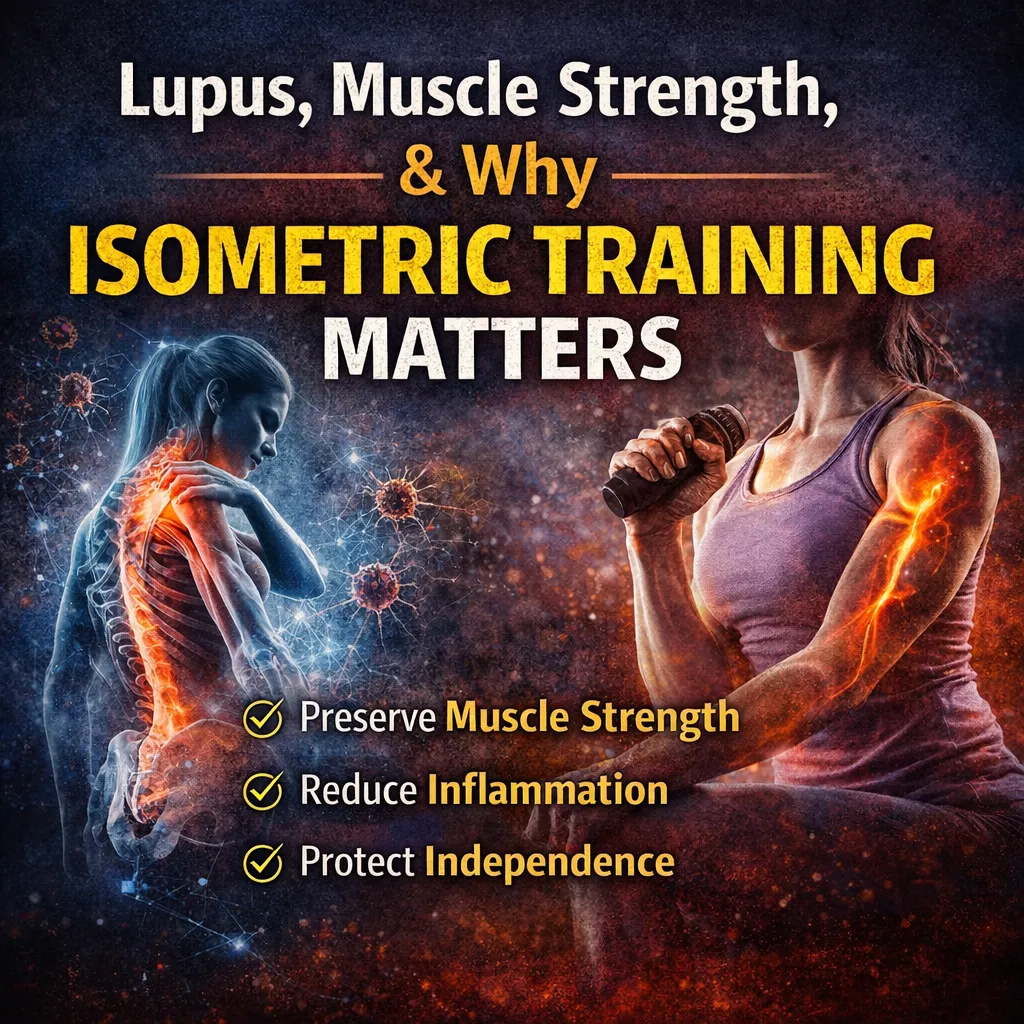
Lupus, Weakness, and the Case for Isometric Training
Lupus, Muscle Strength, and Why Isometric Training Matters
Systemic lupus erythematosus (SLE) is a chronic autoimmune disease in which the immune system attacks the body’s own tissues. It can affect joints, skin, kidneys, blood vessels, the nervous system, and muscles. Symptoms fluctuate, but fatigue, pain, weakness, and reduced physical capacity are common, even when the disease appears stable on lab tests.
One of the most overlooked consequences of lupus is the gradual loss of isometric muscle strength.
This loss rarely announces itself dramatically. Instead, it shows up quietly. Stairs feel slower. Grocery bags feel heavier. Standing from a chair takes more effort. Grip strength weakens. Balance feels less reliable. Over time, these changes directly affect independence, confidence, and quality of life.
Muscle Weakness in Lupus Is Often Misunderstood
Muscle involvement in lupus is frequently misclassified. A 2023 open-access review in Autoimmunity Reviews by Sándor Mogyoróssy and colleagues describes three primary categories of muscle symptoms in autoimmune disease: myalgia (muscle discomfort), myopathy (weakness with or without pain), and myositis (true muscle inflammation).
In lupus, true inflammatory myositis is relatively uncommon. Yet muscle weakness and atrophy are frequently observed and difficult to classify.
This matters because weakness in lupus can arise from multiple sources: immune activity, long-term corticosteroid use, reduced activity due to pain or fatigue, subtle nerve involvement, or a combination of all three. Too often, isometric weakness is dismissed as “just fatigue” or treated solely as inflammation. Neither approach protects long-term function.
Strength Reflects Lived Function Better Than Labs
Recent lupus-specific research reinforces why strength deserves more attention.
In a 2025 multicenter study published in a BMJ journal in partnership with the Lupus Foundation of America, Emerson Pena and colleagues examined muscle health and quality of life in women living with lupus. Muscle strength was assessed using handgrip testing, a direct measure of maximal isometric force production.
The findings were striking. Lower isometric muscle strength, lower muscle-specific strength, and poorer physical performance were all associated with worse quality of life, regardless of disease activity. Even in younger women with inactive or low disease activity, loss of isometric strength strongly predicted difficulty with daily tasks and reduced physical confidence.
The authors concluded that routine assessment of muscle strength should be part of lupus care because strength captures real-world function in ways lab values alone cannot.
Why Isometric Training Is Especially Relevant in Lupus
Many people living with lupus are understandably cautious about exercise. Joint pain, fatigue, nerve symptoms, and fear of flares often lead to avoiding strength training altogether. But the evidence points to a more nuanced reality.
Strength loss worsens outcomes. Preserving strength supports quality of life.
Isometric training offers a uniquely appropriate solution.
Beyond producing force, contracting muscle functions as an endocrine organ, releasing signaling molecules called myokines. These influence immune regulation, inflammation, metabolism, brain health, and tissue repair. Crucially, myokine release is driven by muscle activation and force production, not joint movement.
This distinction is critical in lupus.
Isometric muscle contractions activate muscle without requiring joint motion, impact, or high energy expenditure. This makes them accessible when pain, fatigue, or joint instability limit traditional exercise.
One of the most studied myokines is interleukin-6 (IL-6). While chronically elevated IL-6 is associated with inflammation, IL-6 released from contracting muscle behaves differently. Exercise-derived IL-6 supports anti-inflammatory signaling, improves glucose uptake, increases fat oxidation, and activates satellite cells involved in muscle repair.
In practical terms, controlled isometric contractions can support recovery and systemic health without stressing vulnerable joints.
Protecting Capacity, Not Pushing Limits
For people living with lupus, isometric training may help preserve muscle strength, support nerve–muscle communication, reduce deconditioning during flares, and protect balance, posture, and independence over time.
This is not about pushing harder.
It is about protecting capacity.
Lupus takes many things. But with better education, awareness, and smarter approaches to isometric strength training, it does not have to take everything.
