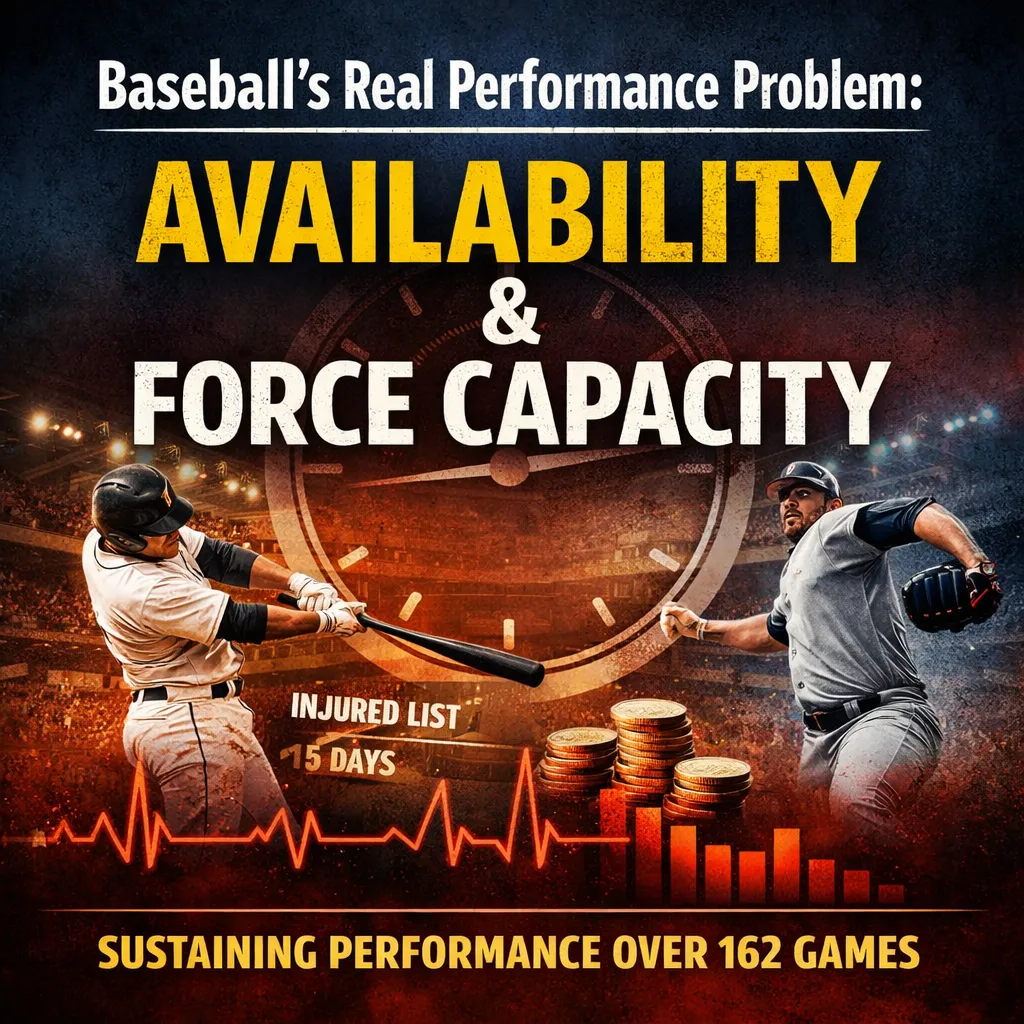
Baseball’s Real Injury Crisis Is Not Injury at All
Baseball’s Real Performance Problem Is Not Talent. It Is Time.
Spring Training is just around the corner. Across the league, rosters are preparing for another long season defined by daily competition, heavy travel, and cumulative workload. As teams ramp toward Opening Day, the question is no longer whether players are talented or prepared.
The real question is whether performance systems are built to survive 162 games.
Baseball is not a short-term performance problem.
It is a season-long exposure problem.
Over the course of a full schedule, force capacity erodes quietly and progressively, often long before it shows up in box scores or injury reports. Teams do not fall short because they lack resources, expertise, or intent. They fall short because many performance systems were never designed to withstand cumulative exposure.
Most systems work well in controlled blocks. They look effective in the offseason. They produce visible gains in isolated phases of the calendar. But once the season begins, once volume, velocity, and repetition stack day after day, those same systems struggle to preserve what matters most: availability.
Performance Degrades Before Injury Appears
Baseball performance exists on a continuum from rehabilitation to game-day power production. Running, throwing, and hitting impose different mechanical stresses, but all rely on the same underlying capacities:
The ability to generate force
The ability to tolerate force
The ability to transfer force
The ability to express force repeatedly without degradation
When any one of these capacities begins to slip, performance becomes fragile long before an athlete is officially injured.
The scale of the issue is no longer theoretical.
Across all 30 teams in Major League Baseball, the league loses an estimated 35,000 to 40,000 player-days per season due to injury. That averages 1,100 to 1,300 days per team every year.
Even calculated using league-minimum salary alone, that equals roughly $145 to $150 million annually paid to unavailable players. That figure is conservative. When adjusted toward mean salaries, the real economic cost climbs into the hundreds of millions, before accounting for performance decline, roster instability, or competitive disadvantage.
The Problem Has Changed. The Tools Have Not.
This is why baseball now requires a new tool, a new concept, and a new methodology. Not for novelty. But because the problem itself has evolved.
Most existing systems were not designed to preserve force capacity across season-long exposure. They manage decline once it appears rather than preventing it from occurring in the first place.
An isometric-led approach reframes the challenge.
When force is trained in a way that prioritizes generation, tolerance, transference, and expression simultaneously, performance can be supported across an entire roster without fixed loads, guesswork, or reactive adjustments. This matters in a 26-man environment where athletes arrive each day in different physical and neurological states shaped by travel, workload, and competition.
Why Isometric Strength Endurance Matters
A central pillar of this approach is building isometric strength endurance through Pushing Isometric Muscle Actions (PIMA).
PIMA allows athletes to express high intent while external load naturally decreases as fatigue accumulates. This creates precision where traditional systems rely on estimation. Force capacity can be trained and preserved across the season, not just in controlled windows.
Across time, that distinction compounds.
Systems centered on dynamic output or static loading struggle to adapt to variability. Systems built on isometric strength endurance provide a stable foundation that integrates seamlessly into warm-ups, recovery days, pre-game preparation, and high-performance sessions without competing with the season itself.
Baseball does not need more effort.
It needs systems that hold up.
The future of performance will belong to organizations that stop asking how to maximize output in isolated moments and start asking how to preserve force capacity across the full competitive calendar.
Availability is no longer a secondary metric.
It is the currency that determines outcomes.
