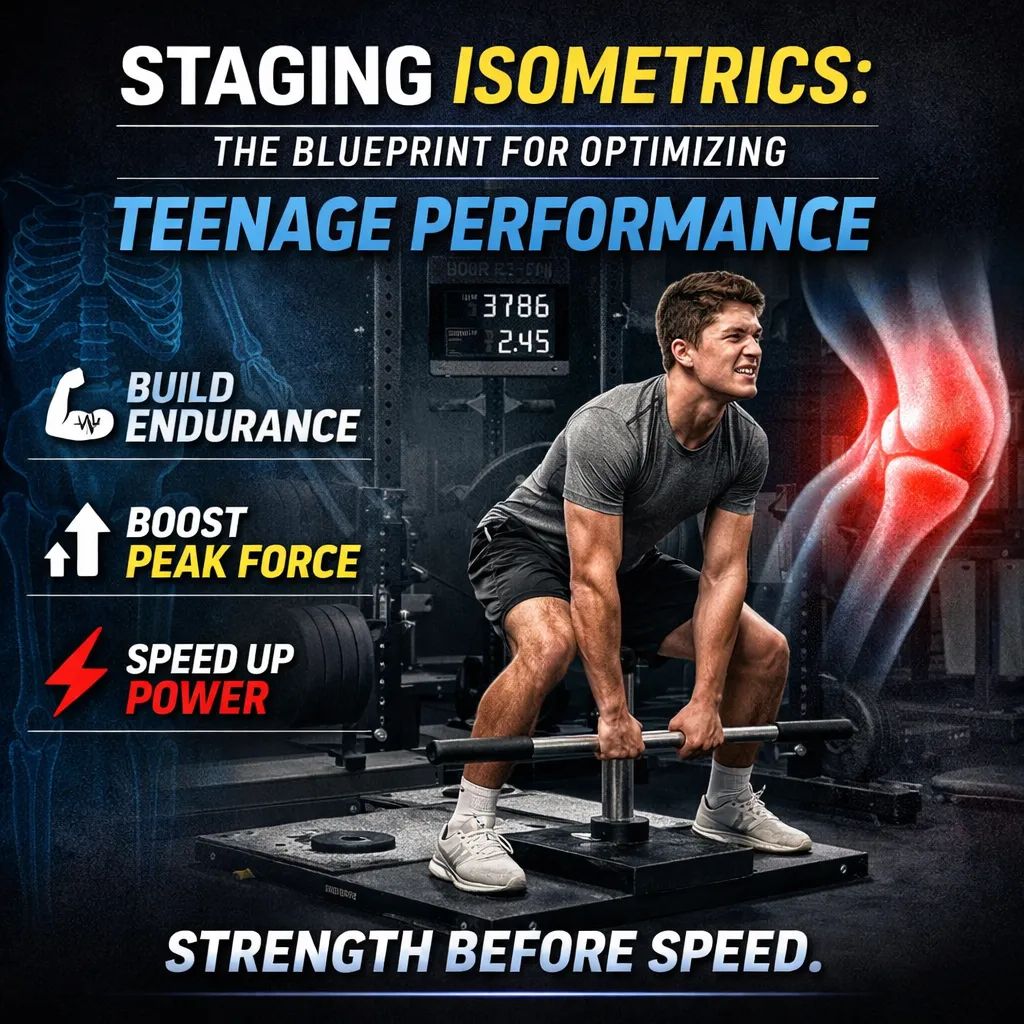
Build the Base Before the Bounce: The Isometric Blueprint for Teens
Adolescence is not a warm-up period for sport. It is a structural inflection point.
During peak height velocity, bones lengthen rapidly. Lever arms change. Joint torques increase. The neuromuscular system must reorganize around a moving skeletal target. Often, limb length increases faster than force capacity adapts. That gap is where instability lives.
In competitive environments that are faster, longer, and more congested than ever, this mismatch shows up late in games.
Non-contact injuries cluster under fatigue.
Hamstrings strain on the final sprint.
ACL ruptures follow repeated decelerations.
Ankles roll after cumulative cutting exposure.
These are rarely isolated events. They are force integrity failures.
When isometric integrity deteriorates, joint alignment drifts, tendon strain rises, and compensations emerge. The athlete does not simply slow down. The athlete becomes mechanically unstable.
Teenage athletes must build isometric force capacity deliberately and sequentially.
Not randomly.
Not reactively.
Sequentially.
Testing Is Not Training
Force plates and isometric mid-thigh pulls are increasingly common in youth performance settings. Objective measurement is a positive shift. Visibility into force production matters.
But measurement does not create adaptation.
Testing provides a snapshot.
Training builds capacity.
Confusing the two creates the illusion of preparedness without the structural margin preparedness requires. If isometric strength is important enough to measure, it is important enough to develop.
A comprehensive isometric profile should examine:
Rate of isometric force fatigue over approximately 45 seconds
Peak isometric force capacity
Rate of isometric force development
These reflect endurance resilience, structural ceiling, and rapid expression. Remove one dimension and the profile becomes incomplete.
What is measured should reflect what is built.
The Three-Stage Isometric Blueprint
Stage One: Isometric Strength Endurance
Fatigue alters joint mechanics. Sustained force decline disrupts motor unit coordination, tendon stiffness regulation, and inter-segmental force transfer.
For adolescent athletes, whose coordination patterns are still refining, this variability can amplify risk.
Isometric endurance extends an athlete’s ability to:
Maintain hip–knee–ankle alignment
Preserve posture during repeated accelerations
Resist mechanical drift late in competition
This is not general conditioning. It is sustained joint integrity under high-load exposure.
Sustained isometric loading also supports tendon stiffness, bone stiffness, and neuromuscular coordination. It refines motor unit consistency under metabolic stress. It develops structural margin while reinforcing mental composure under tension.
Endurance builds durability.
Stage Two: Peak Isometric Force
Peak force raises the structural ceiling.
As limb length increases during growth, torque demands rise. Without proportional increases in force capacity, relative tissue strain increases. And relative strain governs cumulative stress.
Increasing peak isometric force lowers the percentage demand of sport actions. A deceleration that once required near-maximal effort becomes submaximal. Tissue stress drops. Efficiency improves.
Peak capacity must be developed progressively and at joint angles that mirror sport demands.
Capacity reduces risk.
Capacity improves efficiency.
Capacity protects tissue.
But capacity alone is not enough.
Stage Three: Rate of Isometric Force Development
Rate of force development determines how quickly force becomes usable.
In explosive sport movements, time windows are short. An athlete may possess high peak force capacity, but if it cannot be upregulated rapidly, only a fraction contributes to performance.
Early-phase RFD reflects neural excitation speed.
Later-phase RFD is heavily influenced by maximal force capacity.
You cannot express force quickly if you do not possess it.
Sequence governs outcome:
Endurance preserves mechanics under fatigue.
Peak capacity lowers relative strain.
Rapid development allows competitive execution.
Speed must rest on capacity.
Power must rest on integrity.
Without an isometric base, dynamic training becomes unstable force and unregulated load.
Why Adolescence Is the Window
Teenage athletes sit inside a powerful developmental window:
High neural plasticity
Strong tendon adaptation potential
Malleable movement strategies
Build force integrity here and the system reorganizes around stability rather than compensation.
Teach force control before chasing velocity.
Build durability before specialization.
Short, frequent exposures outperform sporadic maximal efforts. Structured sequencing outperforms randomness.
Teenage athletes do not separate themselves by their first jump at kickoff.
They separate themselves by how well they maintain force integrity at the final whistle.
The athlete who can generate, tolerate, transfer, and express force under fatigue holds the structural advantage.
That advantage is built deliberately.
And adolescence is the time to build it.
