Your Strongest Position Might Be Your Biggest Blind Spot
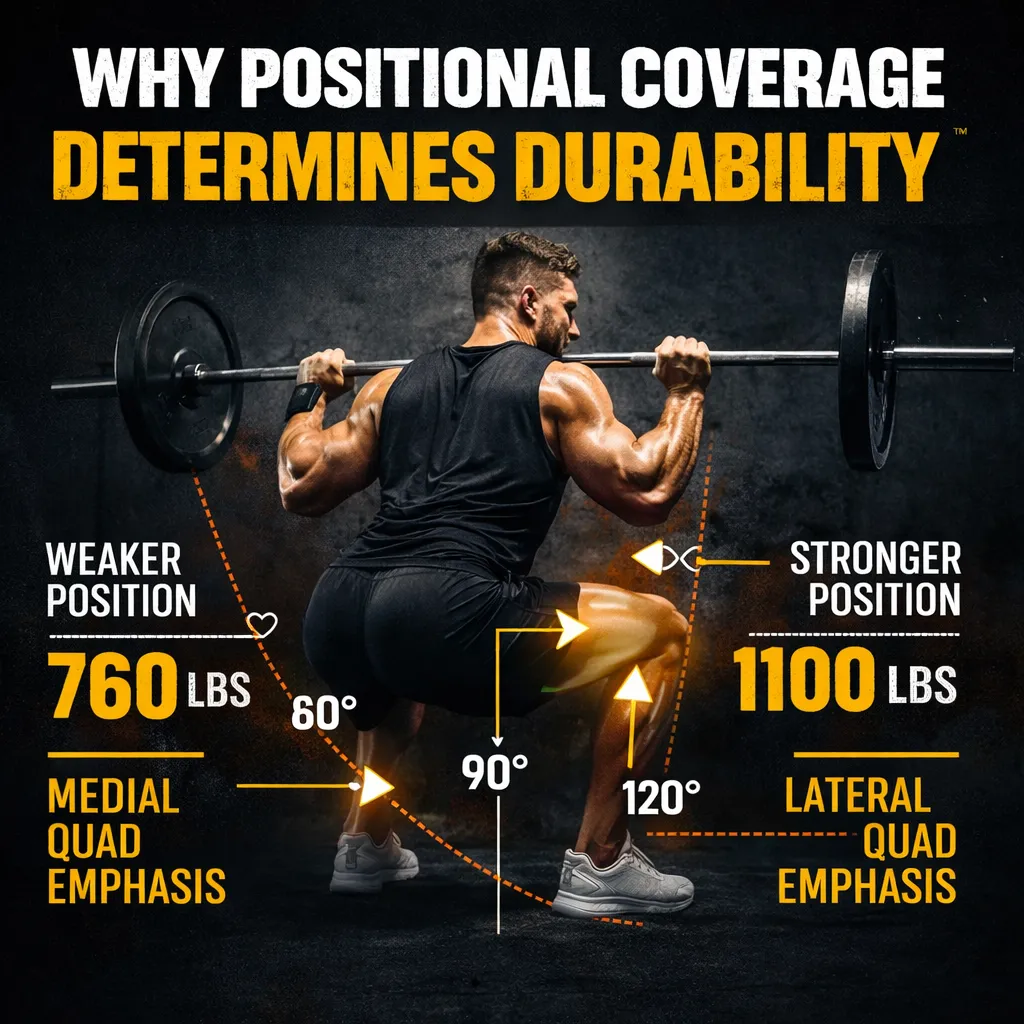
Why Positional Coverage Determines Performance Durability
Recently, I spoke with a strength coach who programs almost exclusively isometric squats and single-leg lunge positions at roughly 60 degrees of hip and knee flexion.
The logic is clean.
The position resembles an athletic stance.
Force expression is strong.
Testing is consistent.
Progress looks measurable.
The numbers improve.
But the real question is not whether force increases at that angle.
The question is whether one joint position represents how force must be organized across the full range where sport imposes its highest torque demands.
That is a different conversation.
A Useful Position Is Not a Comprehensive System
The 60-degree isometric squat has become popular in high-performance settings because it produces reliable peak force and rate-of-force-development data.
It provides a snapshot.
It is useful.
It is simply not comprehensive.
Joint angle changes moment arms.
Moment arms change torque demand.
Torque demand changes neural strategy.
As hip and knee flexion increase beyond approximately 60 degrees, the perpendicular distance between the ground reaction force vector and joint centers typically increases. External flexion moments rise.
As torque demand increases, neural drive must reorganize. Muscular contribution shifts.
The joint angle does not just alter mechanical load.
It alters recruitment strategy.
Same Exercise. Different Muscle Emphasis.
Electromyography research on isometric squats across knee angles shows this clearly.
At approximately 120 degrees of knee flexion, vastus lateralis activation peaks.
At 90 and 60 degrees, vastus medialis becomes more pronounced.
The movement did not change.
The joint position did.
Recruitment emphasis shifted accordingly.
Position changes which muscles lead the solution.
Force Is Position-Dependent Within the Same Athlete
This becomes even more striking when examining isometric deadlift force at different joint positions.
In trained lifters averaging a 1RM deadlift around 555 pounds:
Floor position: ~760 pounds peak isometric force
Knee position: ~920 pounds
Mid-thigh: ~1310 pounds
Lockout: ~1100+ pounds
Same athlete.
Same lift.
Hundreds of pounds difference.
Force expression is not static.
It is position-dependent.
A dynamic 1RM reflects the weakest link in the range.
Isometric testing at multiple angles reveals how force capacity shifts as moment arms change.
That difference matters.
The Strongest Position Is Not Always the Most Relevant
In competitive weightlifters, peak isometric force at the mid-thigh pull is substantially greater than at the start of the first pull.
Yet start-position force correlates more strongly with snatch performance than mid-thigh force does.
The weaker mechanical position proved more predictive of competitive success.
This means different joint positions represent distinct neuromuscular qualities.
They are not interchangeable.
Moment Arms Are Not the Whole Story
Further work examining biarticular hamstrings during multijoint isometric tasks shows that muscle behavior across joint positions cannot be explained by geometry alone.
Neural modulation shifts.
Muscle coordination reorganizes.
Position changes torque magnitude and neural strategy simultaneously.
This is why a single testing angle does not fully describe capacity.
Why Performance Breaks Down Under Fatigue
In high-performance environments, positional instability is often addressed by:
Increasing load
Refining technique
Expanding mobility
All reasonable.
But if position-specific isometric force generation and strength endurance have not been developed across range, improvements at one testing angle may not translate under fatigue.
This explains a common pattern:
Peak outputs improve.
Testing numbers rise.
Recurrent symptoms cluster at specific joint angles.
The governing variable remains underdeveloped:
Sustained torque demand at position.
The Structural Issue Is Positional Coverage
Training at a few joint positions develops a narrow set of force solutions.
Training across many joint positions builds a broader neuromuscular library.
During sprinting, cutting, and landing, ground reaction forces often reach seven to nine times body weight.
Those forces are absorbed at whatever joint angle exists in that moment.
Under fatigue, that angle shifts.
If the system has not practiced organizing force there, coordination degrades despite strong testing numbers elsewhere.
Durability is not built at a single angle.
It is built across angles.
Expand the Preparation Architecture
Preparation should deliberately develop:
Isometric force generation across joint angles
Isometric strength endurance across joint angles
Force tolerance under defined moment-arm conditions
When positional coverage expands, athletes gain more neuromuscular solutions.
When it does not, isolated peak outputs may continue improving while position-specific vulnerabilities persist.
Joint angle alters moment arms.
Moment arms alter torque demand.
Torque demand alters recruitment strategy.
Recruitment strategy determines force capacity at position.
Preparation that reflects that sequence changes outcomes.
Preparation that ignores it leaves blind spots.
