Patellar Tendon Pain Is a Blood Flow Problem First
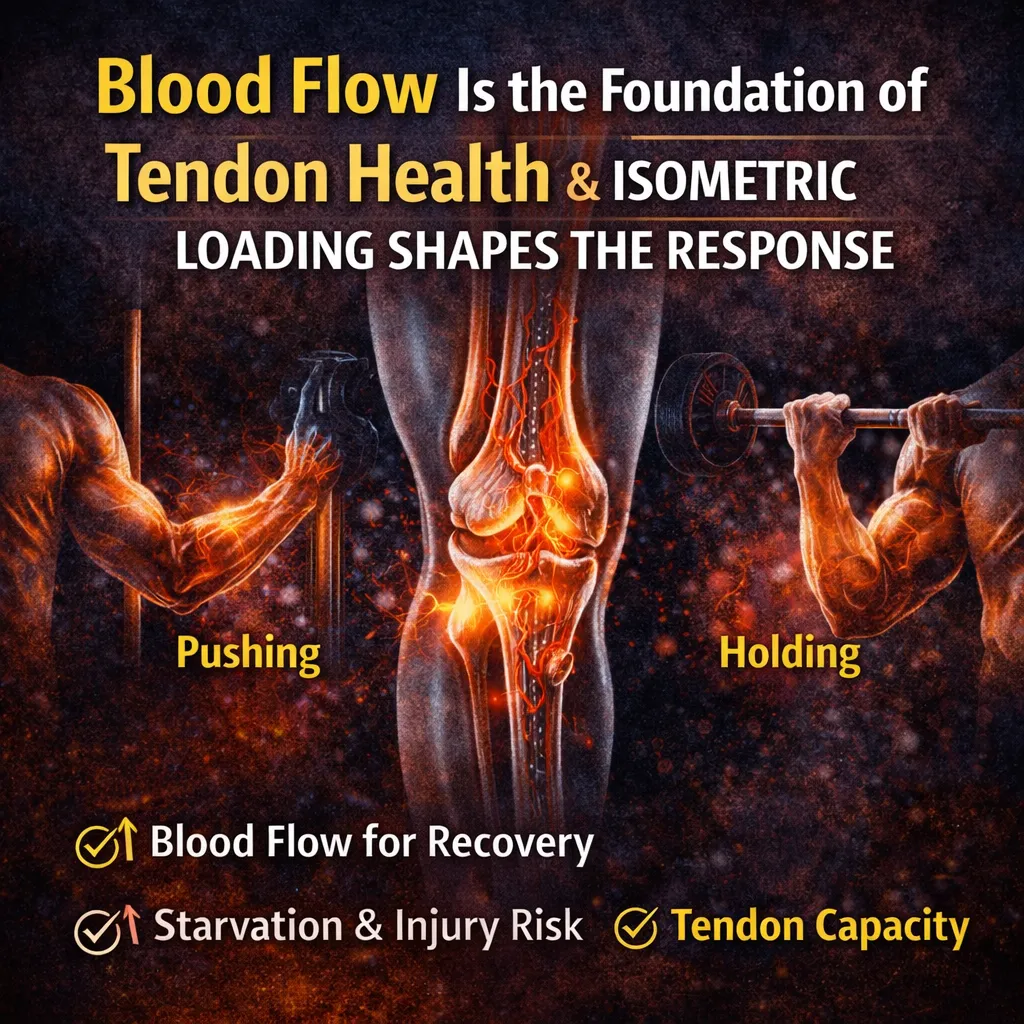
Blood Flow Is the Foundation of Tendon Health and Isometric Loading Shapes the Response
Tendons are uniquely vulnerable tissues. Unlike muscle, they are relatively hypovascular, meaning they receive less direct blood supply. This limited circulation is one reason tendons adapt slowly, struggle to recover from overload, and often become chronic pain points in sport.
If the objective of training is to improve tendon durability, resiliency, and long-term performance, improving tendon blood flow is not optional. It is foundational.
Blood flow delivers oxygen, nutrients, and signaling molecules that regulate collagen turnover, matrix remodeling, and tissue repair. It also clears metabolic by-products that accumulate during mechanical loading. For tissues with limited baseline circulation, the post-exercise increase in perfusion, the hyperemic response, is believed to be a primary driver of recovery and adaptation.
Why the Patellar Tendon Is Especially at Risk
This issue is particularly relevant for the patellar tendon. In youth and adolescent sport, patellar tendon pain is common, especially during periods of rapid growth and escalating training demands. Bone length often increases faster than muscle–tendon units can adapt, increasing tensile stress at the tendon.
Layer repeated jumping, sprinting, and cutting on top of this mismatch, and the patellar tendon is frequently asked to tolerate force without sufficient biological support to recover.
Recent research examining the patellar tendon’s microvascular response to isometric loading provides important clarity.
When isometric knee extensions were performed at varying intensities, tendon blood flow did not increase linearly with load. Low-intensity loading failed to meaningfully increase tendon oxygenation or blood volume. Moderate-intensity loading, approximately 50 percent of maximal voluntary isometric contraction, produced a robust post-exercise increase in oxygenated and total hemoglobin.
Increasing intensity beyond this point did not further enhance tendon blood volume, suggesting a threshold beyond which additional load provides no added vascular benefit.
These findings are specific to the patellar tendon and should not be indiscriminately generalized to all tendons. Tendons differ in anatomy, function, and baseline vascularity. However, given how frequently the patellar tendon becomes symptomatic in jumping-dominant athletes, this evidence provides a valuable framework.
Not All Isometrics Create the Same Tendon Environment
Where this becomes especially important is in understanding how different isometric muscle actions behave under fatigue.
With pushing isometric muscle actions, the athlete actively drives force into an immovable resistance. High intent is often appropriate. As fatigue accumulates, force output naturally declines, creating a descending load profile. The absolute load experienced by the tendon decreases over time. Fatigue acts as an internal regulator that progressively unloads the tissue.
Holding isometric muscle actions behave differently. In a holding task, the athlete resists an external load. As fatigue develops, force capacity declines but the external load remains constant. Relative intensity increases steadily. A load that feels moderate at the start can approach maximal effort by the end of the contraction.
This distinction matters.
Starting a holding isometric too close to maximal effort creates a scenario where relative load escalates rapidly. Intratendinous stress rises, compressive forces increase, and blood flow may be restricted. In tendons already under high cumulative stress, this environment is problematic.
At the same time, holding isometrics that are too light may never reach the intensity threshold required to stimulate a meaningful hyperemic response. The tendon is loaded, but the biological signal needed for adaptation never fully materializes.
Precision Builds Tendon Capacity. Maximalism Does Not.
This is why precision matters more than maximalism.
For holding isometric muscle actions, moderate starting intensities allow sufficient mechanical and metabolic stress to stimulate blood flow while leaving room for fatigue to increase relative demand without pushing the tendon into excessive strain.
For pushing isometric muscle actions, higher intent can be expressed more safely because fatigue progressively unloads the system rather than amplifying stress exposure.
The broader takeaway is simple and often overlooked. Isometric training is not a single stimulus. How force is applied, how fatigue evolves, and how load behaves over time determine whether the tendon experiences a supportive or threatening environment.
Tendon adaptation is not governed by force exposure alone. It is governed by the biological response created during and after loading.
When isometric muscle actions are selected and dosed with intent, especially in populations experiencing high patellar tendon stress, they can improve blood flow, support recovery, and build long-term load tolerance rather than quietly increasing injury risk.
