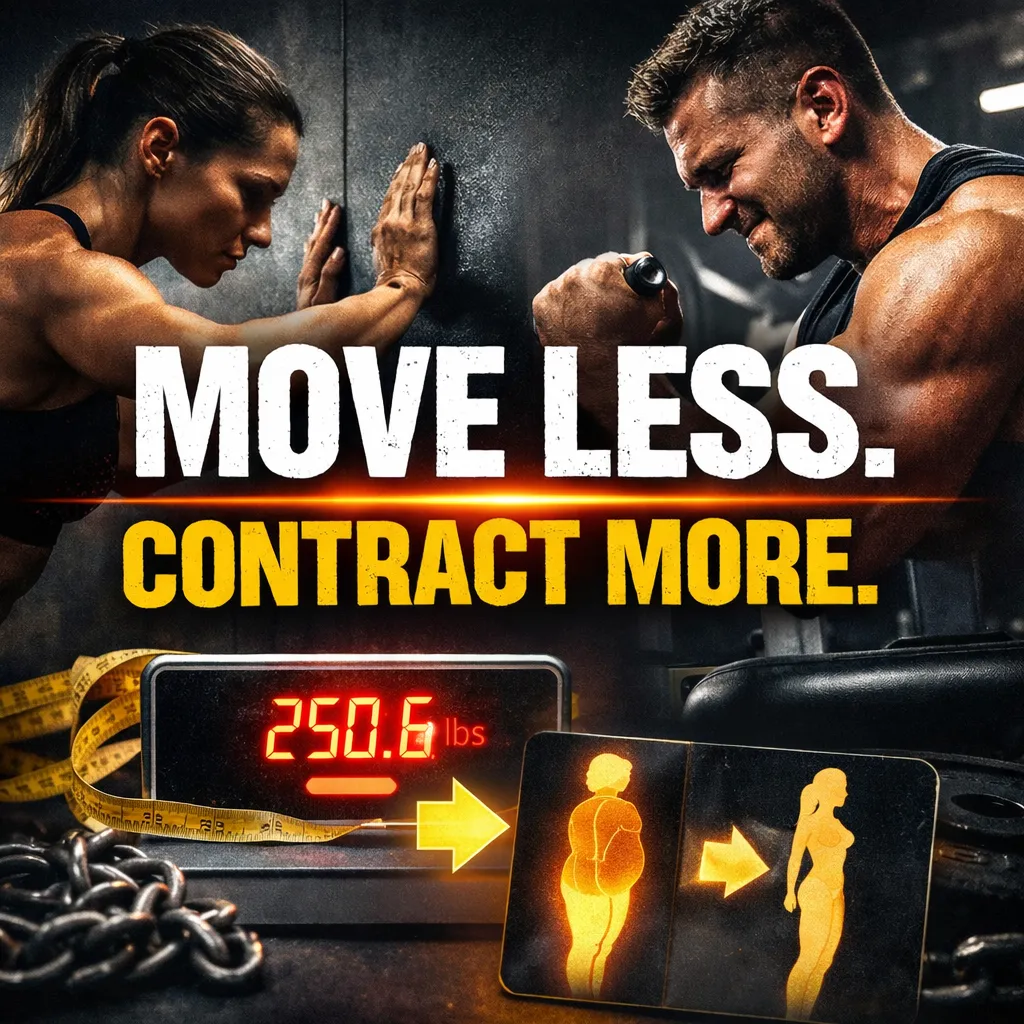
The Science Behind Why Your Workouts Are Not Changing Your Body
Failed to Lose Weight? It Is Time to Move Less and Contract More.
Let us tell the truth.
Most people struggling with fat loss are not lazy.
They are misdirected.
They walk more. They join gyms. They cut calories. They grind. Months go by. The scale moves a little. Energy crashes. Joints ache. Strength does not improve. Metabolism feels slower. Eventually frustration wins.
That is not a motivation issue.
That is a preparation issue.
The body is being asked to change without being given the stimulus that governs structural adaptation.
And the stimulus is not time.
It is tension.
The “Move More” Message Has Not Moved the Needle
For decades, public health advice has repeated the same mantra:
Move more.
Accumulate minutes.
Do more cardio.
If duration were the governing variable, obesity trends would have reversed by now.
They have not.
When a strategy fails to shift behavior and fails to shift physiology, the intelligent move is not to double down on it. It is to refine it.
The body does not remodel itself in response to minutes.
It remodels itself in response to force.
Muscle Adapts to Tension, Not Distance
Skeletal muscle changes when it is required to generate meaningful force.
When contraction intensity is modest, motor unit recruitment remains limited. The adaptive signal to preserve or grow lean tissue stays weak.
And muscle is not cosmetic tissue.
It governs:
Resting energy expenditure
Glucose regulation
Structural support
Joint protection
Metabolic resilience
When muscle is under-stimulated, especially during calorie restriction, the body has no reason to maintain it.
This explains the classic cycle:
Weight drops
Strength drops
Metabolic capacity drops
Plateau hits
Regain follows
Some of that lost weight was muscle.
And metabolism declined with it.
Weight Loss Is Not the Goal. Fat Loss Is.
Total body weight includes:
Muscle
Bone
Water
Organ tissue
Adipose tissue
Reducing scale weight at any cost is not transformation.
The objective is simple:
Reduce excess adipose tissue while preserving or improving force-producing tissue.
That requires mechanical tension.
High Contraction Creates High Adaptation
Muscle responds most strongly to high levels of contraction.
As force output increases:
Motor unit recruitment expands
Neural drive improves
Intramuscular tension rises
Remodeling pathways activate
Research on maximal isometric contractions has shown elevated muscle growth signaling for up to 48 hours after a single high-effort session.
Let that sink in.
No movement.
Just tension.
From a mechanical standpoint, force magnitude governs adaptation more reliably than visible motion.
Even Blood Pressure Data Supports This
A 2023 network meta-analysis in the British Journal of Sports Medicine ranked exercise modalities by effectiveness for lowering resting blood pressure.
Isometric strength training ranked highest.
SUCRA probability: 98.3 percent for systolic reduction
Mean reduction: roughly 8 to 9 mmHg
Aerobic training ranked far lower.
The assumption that endurance volume is superior is not supported by comparative data.
Force wins.
Why Cardio Often Fails Overweight Individuals
This part matters.
Walking and running amplify:
Ground reaction forces
Rotational hip demands
Lumbar spine torque
If muscular force tolerance is insufficient, joints absorb stress they are not prepared to handle.
Pain develops.
Consistency drops.
Confidence erodes.
The individual is not unwilling.
The preparation sequence was reversed.
Build Capacity First. Then Layer Movement.
Moderate to high-effort isometric contraction shifts the sequence.
Isometric loading allows:
Substantial muscular tension
Minimal joint excursion
Controlled environment
Reduced repetitive stress
The joint remains stable while the muscle works intensely.
You build:
Force generation
Force tolerance
Structural confidence
Metabolically, stronger muscle increases resting energy expenditure.
Mechanically, it protects joints.
When force capacity rises, the body has both a metabolic and structural reason to transform.
Shorter Sessions. Greater Impact.
This does not eliminate movement.
It changes the order.
When contraction intensity is sufficient, shorter sessions produce meaningful adaptation because demand per minute is high.
Preparation becomes about muscular capacity, not calorie chasing.
The result?
Lean mass preserved
Fat reduction supported
Blood pressure improved
Joints protected
Long-term resilience enhanced
The Real Cycle That Must Be Broken
Without tension:
More movement gets added.
Fatigue accumulates.
Lean tissue remains under-stimulated.
Results plateau.
With tension:
Muscle receives a clear adaptive signal.
Metabolic capacity improves.
Structural support increases.
Movement becomes easier and safer.
Now the system works with you instead of against you.
Move Less. Contract More.
If you have been grinding through cardio with modest results, the issue is not your effort.
It is your stimulus.
Ask yourself:
Are my muscles being forced to adapt?
Or am I just accumulating minutes?
When contraction capacity develops first, adipose reduction, metabolic efficiency, and mechanical durability begin improving together.
And that is not a temporary drop on the scale.
That is transformation.
