Is Over-Hydration Quietly Increasing Injury Risk in Sports?
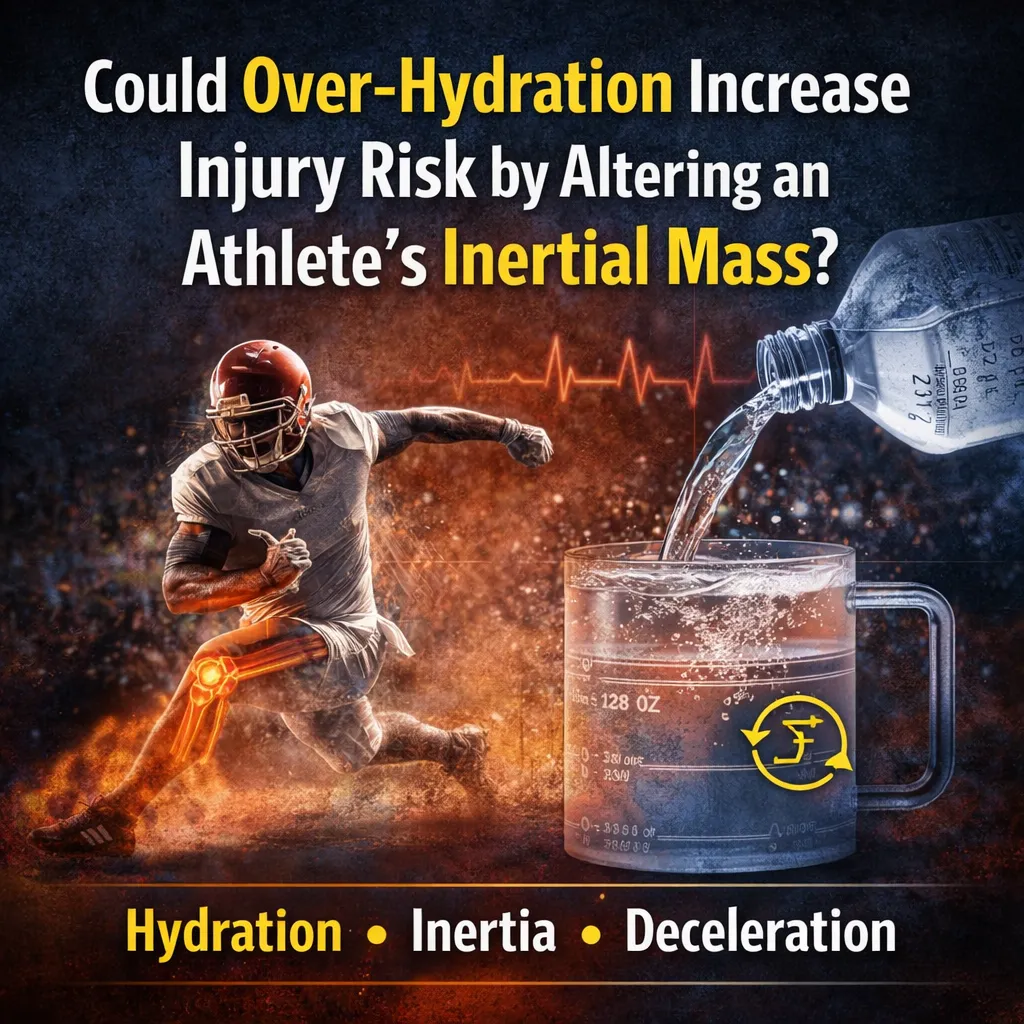
Could Over-Hydration Increase Injury Risk by Altering an Athlete’s Inertial Mass?
Hydration has become one of the most aggressively promoted performance behaviors in modern sport. Athletes are encouraged to drink early, drink often, and err on the side of excess rather than insufficiency. The prevailing logic is simple: dehydration is associated with performance decline, thermoregulatory strain, and elevated injury risk. Therefore, more fluid must be better.
But what if that assumption is incomplete?
What if, in certain contexts, excessive fluid intake subtly alters the mechanical demands placed on the athlete in ways we have not fully considered?
To explore this, we must step away from purely metabolic and cardiovascular perspectives and examine the athlete through a biomechanical lens, specifically through the concept of inertial mass.
Internal Mass Still Obeys the Laws of Motion
A useful analogy comes from fuel transport trucks. When a tanker carries large volumes of liquid, the danger is not only the weight of the fuel, but how that mass behaves during sudden braking or rapid changes in direction. Fluid surge creates additional forces that destabilize the vehicle. To manage this, tankers use internal baffles to limit slosh and reduce inertial stress.
The lesson is straightforward.
Uncontrolled internal mass increases mechanical instability during rapid motion.
Now consider the human athlete.
The human body is approximately 60 to 70 percent water, distributed across intracellular, interstitial, and intravascular compartments. Under normal conditions, this fluid is tightly regulated and integrated into tissue structures. During aggressive hydration, especially when intake exceeds immediate physiological demand, temporary shifts can occur: expanded plasma volume, increased interstitial fluid, localized tissue swelling, and gastrointestinal fluid load.
Human fluids do not slosh freely like fuel. They are constrained by fascia, connective tissue, membranes, and pressure gradients. But they are not mechanically irrelevant.
Fluid has mass.
Mass contributes to inertia.
Inertia matters during rapid deceleration, cutting, landing, and re-acceleration.
The Mechanical Cost of Extra Water
Three to four liters of water, an amount many athletes consume in the hours leading into competition, adds approximately 3 to 4 kilograms, or 6.6 to 8.8 pounds, of mass.
From a mechanical standpoint, that is not trivial.
This additional mass must be accelerated, decelerated, and stabilized during high-velocity sporting actions. In static conditions, this may be inconsequential. Under rapid braking or directional change, even modest increases in mass can amplify inertial demands on joints, connective tissue, and stabilizing musculature.
Relative change matters as much as absolute load.
A 225-pound running back and a 180-pound wide receiver may both consume the same volume of fluid, but the lighter athlete experiences a larger relative increase in total body mass. That difference may meaningfully alter force demands during cutting and deceleration, where margins for error are already narrow.
Where Risk Actually Shows Up
In sport, injury risk spikes most often during high-deceleration events, not steady-state movement.
Cutting
Landing
Braking
Re-acceleration
These moments place large transient forces on the system that must be absorbed and redirected rapidly. Safety depends on the athlete’s ability to generate isometric force, stabilize joints before and during motion, and control internal mass relative to external forces.
If total system mass increases, and force tolerance does not scale with it, vulnerability increases.
This is most apparent at the knee during cutting, the ankle and foot during landing, the trunk during rotational deceleration, and the cervical spine during rapid head braking.
This Is Not an Anti-Hydration Argument
Adequate hydration is essential for performance, cognition, and health. This is not an argument for restriction or dehydration.
It is an argument for precision.
An athlete with high whole-body force tolerance and isometric capacity may manage fluctuations in internal mass without issue. A fatigued athlete, an under-prepared athlete, or one returning from injury may not.
Strength without control increases injury risk.
Mass without sufficient force tolerance does the same.
Most hydration research focuses on thermoregulation, cardiovascular strain, endurance, and heat illness prevention. Very little work has examined hydration through a mechanical or inertial framework, particularly in explosive, multi-directional sports where injury risk is highest.
This does not mean over-hydration is inherently dangerous. It means we may be overlooking an important variable.
Sport does not punish athletes for being under-hydrated alone.
It punishes them for being unable to control force under rapidly changing conditions.
Hydration should support performance.
Force capacity must govern it.
This is not settled science.
But it is a conversation worth having.
